William Fan at ten: a brand outgrowing its system
William Fan is a Berlin-based fashion label at a ten-year inflection point. Founded in 2015 by a German designer with Chinese immigrant roots, the brand produces ready-to-wear, shoes, bags, jewelry, furniture, and objects. It shows regularly at Berlin Fashion Week, has a flagship store, and recently launched FAN PLAZA, a separate retail concept for gifts, stationery, and curated objects. The latest collection, “Ring the Bell,” signals reflection and continuity, not reinvention.
I scored 30 public signals across the brand. Three clusters survived.
Perception
William Fan says it creates “a uniform and timeless look which incorporates both Chinese and European influences” with “precise yet playful tailoring” that bends “the boundaries of both gender and culture.” The designer trained at Alexander McQueen and studied at ArtEZ and Weißensee. The work is serious.
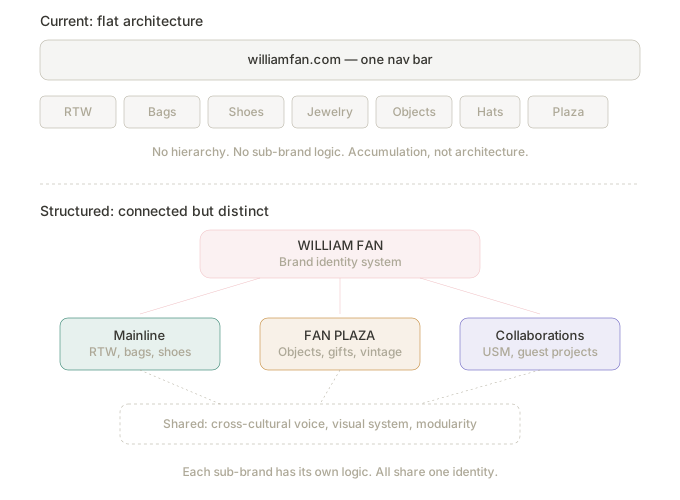
But the brand system doesn’t match the vision’s coherence. The website splits into seven top-level navigation categories (current collection, shop, selections, projects, story, store, FAN PLAZA) with no visual hierarchy telling the visitor what matters most. The product range spans blazers at €1,850, pants at €550, coats at €2,059, down to massage tools and hair brushes in FAN PLAZA. The expansion is ambitious for a ten-year-old independent label. Without a visible architecture connecting these categories, the site communicates accumulation, the opposite of the designer’s stated philosophy of precision and balance.
The designer’s interview voice is specific, personal, and culturally grounded. “Being the child of Chinese immigrants and growing up in the diaspora was something I took for granted. But over time, my perception of myself and my family’s culture has constantly evolved.” The brand’s website voice is generic luxury copy: “Discover the world of WILLIAM FAN. Our exclusive collections combine timeless design with innovative materials.” The gap between how the founder speaks and how the brand speaks is the clearest signal that the identity hasn’t kept pace with the vision.
Structure
William Fan occupies a distinctive competitive position.
| Brand | Base | Price tier | Cross-cultural signal |
|---|---|---|---|
| William Fan | Berlin | €550–€2,100 | Chinese-German, explicit |
| Lemaire | Paris | €300–€2,000+ | Franco-Asian, embedded |
| GmbH | Berlin | €200–€800 | Pakistani-German |
| Bode | New York | €300–€2,000 | American patchwork heritage |
| Jil Sander | Milan | €500–€3,000+ | German minimalism |
No direct competitor does what William Fan does: a Berlin-based label with explicit cross-cultural Chinese-European DNA, genderless and seasonless, expanding into objects and lifestyle beyond fashion. The closest parallel is Lemaire, which is cross-cultural, modular, expanding beyond clothing, but Lemaire is an order of magnitude larger and has a more refined brand system.
The FAN PLAZA launch is the most interesting signal. A second retail concept (gifts, objects, stationery, vintage) suggests the designer wants to build a world, not just a clothing line. “I love building worlds and trying out lots of product groups” (from an interview with USM). But world-building requires a brand architecture that can hold multiple concepts under one coherent identity. Right now, FAN PLAZA is a collection page within the main Shopify site. It reads as an add-on, not a sub-brand.
Alignment
The cross-cultural positioning is William Fan’s most defensible asset. It is also the most understructured.
The biographical signal is strong. The designer speaks openly about growing up in the Chinese diaspora in Germany, about traveling to Hong Kong and China and “discovering a new world that I was very familiar with,” about searching for balance between European and Asian values. This isn’t performed. It’s lived.
The design carries the cultural dialogue. Asian closing techniques meet European tailoring. Collection names draw from cultural moments: “Lunar,” “Ceremony,” “Neighbourhood.” Materials cross traditions: silk and cashmere alongside technical fabrics, furniture-industry textiles repurposed for ready-to-wear.
But the brand doesn’t communicate this systematically. The collection stories that give the fashion shows their depth never reach the website. The cultural references that make the runway presentations meaningful are invisible to the online customer. And the most obvious market alignment (a Chinese-German brand has natural audiences in Greater China, DACH, and the global Chinese diaspora) is completely unbuilt. The website is English and EUR only. No Chinese-language presence. No localized content for Asian markets.
A brand whose strongest competitive advantage is cross-cultural fluency has no digital infrastructure for reaching the cultures it draws from.
Three clusters
Brand architecture gap. The label is expanding into multiple product categories and a second retail concept without a visible system connecting them. Fashion, objects, and FAN PLAZA need to relate through a coherent architecture. Currently they share a navigation bar and nothing else.
Cross-cultural positioning underbuilt. The Chinese-European dialogue is stated on the about page but not structured into the brand experience. The Asian market path is obvious (the cultural DNA is already there) but the infrastructure doesn’t exist.
Voice-identity mismatch. The designer has a strong, specific, culturally grounded voice in every interview. The brand has generic luxury copy on its website. The gap means the brand is less interesting than it actually is, to everyone who doesn’t attend the fashion shows or read the press coverage.
What the pipeline couldn’t evaluate
Whether the label is actively looking to evolve its brand system. The brand’s financial position and team size. Whether the FAN PLAZA expansion is a strategic commitment or an experiment. The founder’s timeline and appetite for the Asian market. Whether existing agency or design relationships are in place. These are questions the pipeline can surface the need for, but only a conversation can answer.