What 40 signals reduce to 3
MBzwo is a German custom solid wood furniture manufacturer. The workshop behind it was founded in 1973 by grandfather Heinrich in Verl, Ostwestfalen, the historic center of German furniture making. Three generations later, the family still runs the workshop. In 2016, founder Karina Buschsieweke launched MBzwo as a direct-to-consumer brand, bringing the workshop’s made-to-order tables online. They have showrooms in Berlin and Verl. Tables start around €3,000.
I ran the brand through my pipeline to see what was there.
Perception
The pipeline ingested 40 public signals across six categories: positioning, visual identity, voice and tone, digital experience, market and culture, and cross-cultural alignment. Sources included the MBzwo website, competitor sites, design retailer listings on Connox, smow, and AmbienteDirect, and broader industry context around the German solid wood furniture market.
The first thing the pipeline surfaced was a pricing comparison I hadn’t expected to be this stark.
| Brand | Product | Size | Price |
|---|---|---|---|
| MBzwo | Traditional (Asteiche) | 180×90cm | €3,059 |
| OUT Objekte unserer Tage | Meyer (waxed oak) | 200×92cm | €1,890 |
| OUT Objekte unserer Tage | Meyer 23 (waxed oak) | 200×92cm | €2,490 |
| e15 | Fayland (oiled oak) | 250×100cm | €5,919 |
MBzwo charges 60% more than OUT’s entry table but presents like a budget online store. It charges roughly half what e15 charges but has something e15 doesn’t. And this turned out to be the most important signal in the entire analysis.
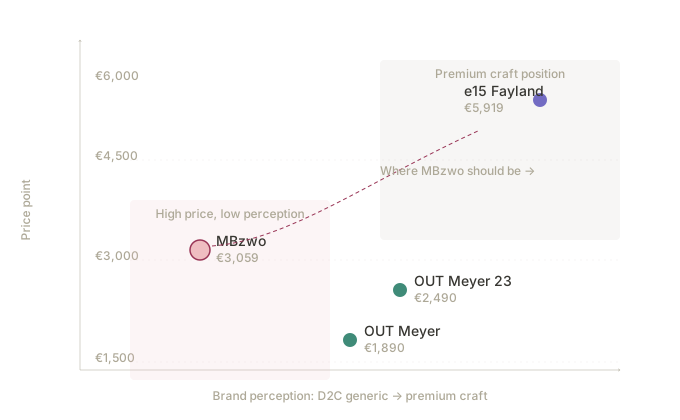
Both e15 and OUT outsource their manufacturing. e15 works with “specialised European craftsmen.” OUT produces in “selected German craft businesses.” Neither owns a workshop. MBzwo does. Three generations. Fifty-plus years. The same family, the same building, the same wood.
A brand with stronger provenance than its most prestigious competitor is presenting itself as a generic D2C furniture store.
Structure
The pipeline organized the 40 signals into five clusters.
Cluster A: Heritage undersold. The three-generation workshop story, the Ostwestfalen location, the 1973 founding. These appeared in a subheading and a single paragraph on the “Über uns” page. The homepage led with “Massivholzmöbel nach Maß” (custom solid wood furniture), which is a category description, not a positioning statement. The word “Manufaktur,” one of the most powerful words in German consumer culture, appeared once, in passing.
Cluster B: Premium perception eroded. A newsletter popup offering €250 off greeted visitors on arrival. A “10% Herbst Angebot” (autumn sale) banner ran across the page. The site was built on Elementor with a template-driven layout visible in the section structure. The product grid, the popup, the discount banner. Every convention signaled mid-market D2C. This is a brand training customers to expect sales on handmade tables that take weeks to produce.
Cluster C: Language and market gap. The site was German-only, with English phrases dropped in randomly. “Solid wood at it’s best” appeared on the homepage, with the wrong apostrophe. “From our family to yours” sat alongside German marketing copy with no coherent bilingual strategy. The Berlin showroom, located in a city with a large international design community, offered no English-language experience. The B2B page, which could serve international hospitality clients, had no English entry point.
Cluster D: Configurator underused. The made-to-order custom model was the business differentiator but not the brand differentiator. The product configurator existed but wasn’t the hero experience. Wood sample ordering and video consultation, excellent trust-building services, were buried in the service menu.
Cluster E: Content absence. No editorial content. No material stories. No maker profiles. No workshop photography on the homepage. The craft that makes the product exceptional was invisible. Product descriptions were functional: dimensions, wood types, prices. In a market where Manufactum proves that material storytelling sells, this silence is expensive.
Alignment
The language gap was more than a web design issue. It was a cross-cultural alignment failure.
Berlin is an international city. The showroom on Köpenicker Chaussee serves architects, expats, and design tourists who may not read German fluently. The tables ship across Europe. But the brand had no infrastructure for any audience beyond German-speaking consumers.
The English that did appear wasn’t edited, wasn’t consistent, and wasn’t strategic. It was decorative. A few phrases scattered across a German site as if proximity to English words would signal internationality. It didn’t. It signaled that no one was paying attention.
For a brand with genuine European appeal (handmade, regional, sustainable, customizable) the absence of a considered language strategy was leaving the brand’s strongest potential markets completely unaddressed.
Identity
I cut two clusters and kept three.

Clusters D and E were cut. The configurator and content gaps are real, but they’re symptoms. If you don’t know what the brand voice is, you can’t write material stories. If you haven’t established the brand as a workshop rather than a store, making the configurator the hero experience won’t land. These are second-order problems. Fix the positioning and the premium perception first, and the configurator and content follow naturally.
Cluster A survived because it’s the one thing no competitor can claim. e15 outsources manufacturing. OUT outsources manufacturing. MBzwo owns the workshop. 1973. Three generations. Ostwestfalen. This is not a marketing story. It’s a structural advantage. It’s the core.
Cluster B survived because it’s actively working against the product. Every discount popup, every sale banner, every template section tells a €3,000 table buyer that this is not a serious brand. The erosion is mechanical. The conventions of D2C e-commerce are designed for volume at low margins, not craft at premium prices. Removing them isn’t a design choice. It’s a strategic correction.
Cluster C survived because it connects the brand’s strongest asset (provenance, craft, regionality) to its largest untapped market (international buyers in Berlin and across Europe). And because it’s the exact kind of problem I built my methodology to solve: a brand that needs to work across cultures without losing what makes it specific.
Foundation
The output direction is a repositioning, not a redesign.
MBzwo should move from “online furniture store with family heritage” to “third-generation Ostwestfalen Manufaktur, now direct.” The workshop is the brand. The heritage is the proof. The direct model is the mechanism, not the identity.
Everything that makes MBzwo look like Home24 gets cut. Everything that makes it feel like a workshop visit gets amplified. The discount popups go. The sale banners go. The Elementor template gets replaced with something that reflects the product quality. The configurator becomes the centerpiece experience. And the language strategy gets built. Not translated, but built from the ground up for a brand that speaks German at home and needs to speak to the world.
What the pipeline couldn’t evaluate
Whether the founder wants to reposition upmarket or stay D2C mid-market. Whether workshop capacity supports premium pricing and slower sales cycles. Whether the family is comfortable being the brand: faces, names, stories in the foreground. Whether there’s budget and appetite for a bilingual site. Whether the designer collaborations are ongoing or one-off. These are questions for a conversation, not a pipeline.
The signals are all there. They’re buried under e-commerce conventions that work against the product. The brand’s job is to stop hiding the workshop behind a store.