Lemaire: how to scale quiet
Lemaire is a Parisian fashion house that built a €100M business (revenue grew tenfold from €10M to over €100M between 2019 and 2024, as reported by Business of Fashion) by positioning against luxury’s loudness. Then had to figure out how to scale quiet.
Perception
Lemaire communicates restraint as a value system, not an aesthetic choice. The collections are muted (charcoal, olive, fawn, cream), the silhouettes are androgynous and modular, the construction is visible but never showy. The Croissant Bag became an icon precisely because it doesn’t look like it’s trying to be one.
The brand voice, what little exists publicly, is spare. Christophe Lemaire in interviews: “Reality isn’t a dirty word.” “Helping each and every person find his own uniform.” These aren’t taglines. They’re positioning statements disguised as personal convictions. That’s the strongest kind.
The website is almost anti-commercial. Product photography is editorial, not e-commerce. No lifestyle imagery. No influencer content. No sale section visible. The Shopify backend is invisible under a restrained custom front end. This is a brand that makes you work slightly harder to buy. And that friction is the signal.
Structure
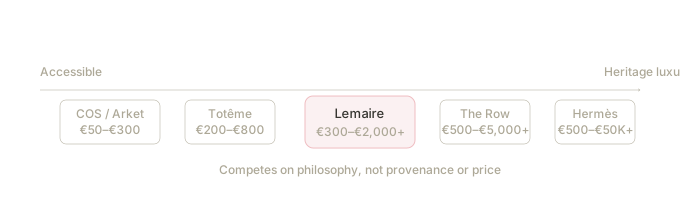
Lemaire operates in the space between accessible luxury and legacy luxury. The positioning is precise.
| Brand | Price tier | Signal | Positioning |
|---|---|---|---|
| COS / Arket | €50–€300 | Affordable minimalism | Design-conscious basics |
| Totême | €200–€800 | Scandi quiet luxury | Capsule wardrobe for the Instagram-literate |
| Lemaire | €300–€2,000+ | Intellectual utility | Wardrobe as modular system |
| The Row | €500–€5,000+ | Ultra-quiet American luxury | Stealth wealth perfected |
| Hermès | €500–€50,000+ | Heritage maximalism | The ultimate quiet flex |
Lemaire sits above the accessible tier without competing with the heritage tier on provenance or price. It competes on philosophy: the idea that clothes are tools for living, not symbols of status. This is a defensible position because it’s rooted in the designers’ actual convictions, not a marketing strategy.
The Uniqlo paradox
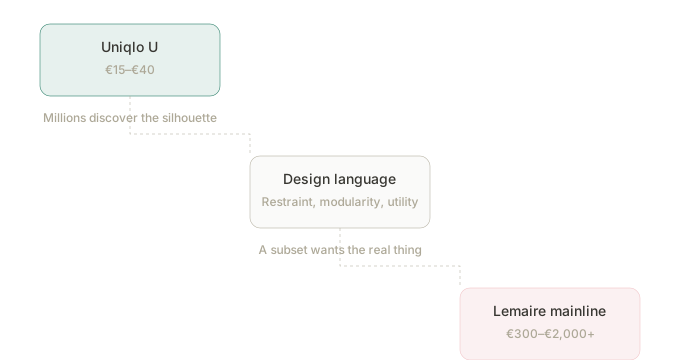
The single most unusual structural decision in luxury fashion: the creative director of a €100M Parisian label simultaneously designs for the world’s largest fast-fashion retailer. Uniqlo U sells t-shirts for €15 and trousers for €40. The same hands, the same philosophy, a fraction of the price.
In traditional luxury, this would be brand suicide. But Lemaire flipped the script: Uniqlo U became the entry point, not the exit. It introduced millions of consumers to the Lemaire design language at accessible prices. Those who wanted more (better fabric, more considered construction) traded up to the mainline. Fast Retailing (Uniqlo’s parent) liked it enough to acquire a minority stake in 2018.
This only works because Lemaire’s positioning is about design philosophy, not material exclusivity. If the brand’s value were in the fabric or the logo, Uniqlo U would undermine it. But because the value is in the thinking (the silhouette, the modularity, the restraint) the cheap version doesn’t cheapen the expensive one. It validates it.
Alignment
This is where Lemaire becomes a case study for how cross-cultural fluency shows up in brand positioning. Not as a strategy, but as an inevitability of who makes the work.
The design carries multiple cultural vocabularies without labeling any of them. Lemaire’s collections draw on Japanese construction sensibility, French restraint, Southeast Asian draping, and a looseness that resists easy categorization. The founders have spoken openly about these influences: Christophe has cited Yohji Yamamoto and Rei Kawakubo as formative, described a childhood between France and Senegal, and the Spring/Summer 2024 collection drew from a journey to Vietnam. Sarah-Linh Tran, who trained as a literary publisher, has brought what she’s described as a focus on “suggestion” and bodily freedom to the collections.
What’s notable is how the brand handles this. There is no “global inspiration” section on the website. No diversity statement. No mood boards labeled “Tokyo” or “Dakar.” The influences arrive in the clothing (in the cut, the drape, the proportion) and the customer either recognizes them or simply experiences them as good design. The brand trusts the work to carry the cultural fluency without narrating it.
This is why the brand travels. Lemaire’s largest growth markets are South Korea, Japan, and China. The design philosophy (restraint, utility, modular layering, quality materials, anti-logo) resonates deeply with East Asian consumers who are moving past logo-driven luxury. The brand didn’t adapt to these markets through localization. The markets recognized something already present in the design.
Brands that perform cross-cultural awareness (flags, translations, “inspired by” copy) tend to flatten the cultures they reference. Brands where cross-cultural fluency is embedded in the makers’ lived experience tend to produce work that travels without explanation. Lemaire is the latter. The positioning lesson isn’t “hire diverse people.” It’s that authentic cultural range produces design that doesn’t need a market expansion strategy to expand.
Identity
In 2014, “Christophe Lemaire” became “LEMAIRE.” The founder has said publicly that naming the brand after himself was his biggest regret. Removing the first name shifted the brand from auteur to institution, from a person’s taste to a shared philosophy. This is a rare act of ego reduction in an industry that worships the designer-as-genius.
The modular wardrobe concept is the product-level positioning. Lemaire pieces are designed to combine across seasons and collections. Buy a jacket in 2022, pair it with trousers from 2025. The brand explicitly asks customers not to chase newness but to build. This is anti-fashion positioning that works because the design consistency is real, not just a marketing claim.
The Croissant Bag is an accident that proves the positioning. A soft, curved, unglamorous bag shape that became Lemaire’s most recognizable product. It succeeded because it embodies the brand’s values: functional, tactile, understated, instantly recognizable without a logo. The bag is famous for what it doesn’t do.
Foundation
The proof points hold up.
Revenue tenfold in five years, 2019–2024 (Business of Fashion, January 2025). Hermès creative directorship on Christophe’s CV from 2010 to 2014. Fast Retailing minority investment in 2018. Flagship stores in Paris, Milan, Seoul, Tokyo, Shanghai, and Beijing. Uniqlo U as a global awareness engine. Fabrics sourced primarily from Europe and Japan. Production in Europe, Turkey, and Morocco. Not a “Made in France” purist, but transparent about it.
What could break the positioning: scale itself. Quiet luxury at €100M is different from quiet luxury at €10M. More stores, more products, more marketing. Each increment of growth puts pressure on the restraint that defines the brand. The Uniqlo dependency is real. If the partnership ends, Lemaire loses its most powerful awareness channel. And succession is untested. The name change from “Christophe Lemaire” to “LEMAIRE” was prophetic, but whether the institution can carry the philosophy without its founders remains an open question.
The “quiet luxury” trend normalizing is the subtlest risk. When Succession made stealth wealth a cultural moment, it benefited Lemaire. But if every brand claims to be quiet, the positioning loses its contrast. Lemaire has to stay ahead of the trend it accidentally helped create.
Expression
The website is built on Shopify but disguised under a restrained editorial front end.
What works: product photography is consistent, spare, and editorial. Navigation is minimal. The “Projects” and “Shows” sections position the brand as a cultural entity, not just a retailer. The about page is concise and specific.
What doesn’t: the site is slow. Shopify’s weight shows on mobile. There’s no editorial content beyond collections and shows. No journal, no essays, no interviews. For a brand built on philosophy, the website is surprisingly philosophy-free. You have to read SSENSE interviews and BoF profiles to understand what Lemaire actually thinks. The e-commerce experience is generic beneath the editorial layer. Product pages are standard Shopify, identical to every other store on the platform. And for a brand whose strength is cross-cultural fluency, the website has no acknowledgment of the Japanese influence, the Vietnamese journey, the Senegalese roots. The design carries it. The words don’t.
The positioning gap
Lemaire’s positioning is nearly flawless at the product and philosophy level. The gap is in the communication layer.
The brand relies on external voices (Business of Fashion, SSENSE, Vogue, retail partners) to articulate its philosophy. The brand itself barely speaks. There is no owned editorial. No process documentation. No transparency about sourcing beyond a single sentence.
This works today because Lemaire is still small enough that the design speaks for itself and the press speaks for the brand. At €100M and growing, with flagships on three continents and a Uniqlo partnership, the brand needs a self-authored voice. Not louder, but present. The cross-cultural fluency that makes the brand travel so well is invisible to anyone who doesn’t read fashion journalism. The brand’s next phase of growth will require making this philosophy accessible without making it loud. That’s the design problem Lemaire hasn’t solved yet.